ID-Verified LinkedIn Accounts: What They Are and When Your Outreach Actually Needs One (2026)
ID verification is one of the most misunderstood settings in LinkedIn outreach. This guide explains what a verified account is, how the badge affects trust and restriction risk, when a verified profile is worth the premium, and how AIA lets you mix ID-verified and standard avatars across a fleet without overpaying on every seat.
If you have shopped for LinkedIn accounts to run outbound, you have probably seen the term “ID verified” attached to a higher price and wondered whether it actually matters. Some providers treat it as a premium upsell. Others do not offer it at all. The honest answer is that verification matters a lot for some parts of an outreach program and very little for others, and knowing the difference is what keeps you from either overpaying on every seat or running fragile accounts where you needed strong ones.
This post explains what an ID-verified LinkedIn account is, how the verification badge changes the way the platform and your prospects treat the profile, when a verified account is worth the premium, and how to structure a fleet so you pay for verification only where it earns its keep.
What “ID Verified” Actually Means on LinkedIn
LinkedIn offers a verification feature that lets a member confirm their identity through a government ID or a workplace check. When it is complete, the profile carries a verification indicator that other members can see. It is not the same as the old blue influencer badge, and it is not a paid ad product. It is a trust signal that says the person behind the profile passed an identity check.
For outreach, the important part is not the badge as a vanity marker. It is what the badge signals to two audiences at once: the platform’s own trust systems, and the human prospect deciding whether to accept your connection request or reply to your message.
Why Verification Changes Restriction Risk
Every LinkedIn account operates against a trust score that the platform maintains behind the scenes. New, thin, or suspicious profiles sit low on that scale and get restricted faster when they send volume. A profile that has passed identity verification starts from a stronger position because the platform has more confidence that a real, accountable person stands behind it.
That does not make a verified account immune. No account is immune. Send 200 connection requests a day from a cold profile and you will hit a wall no matter what badges it carries. What verification buys you is more headroom and a faster path back if something goes wrong, because the account is easier for the platform to trust when it reviews activity. Pairing that with proper warm-up, realistic daily limits, and a proxy that matches the profile geography is how serious programs keep accounts alive. If you want the mechanics of that, see how AIA builds and warms its avatars.
Why Verification Changes Reply Rates
The second audience is the prospect. When someone gets a connection request or a cold message, they make a snap judgment about whether the sender is real. A verified profile clears that first hurdle faster. It reduces the “is this a bot” hesitation that kills acceptance rates, especially with senior buyers who are careful about who they connect with.
This is where verification earns money rather than just reducing risk. A slightly higher acceptance rate compounds across every step of a sequence. If verification lifts your connection acceptance even a few points, that flows into more conversations, more meetings booked, and more pipeline, from the exact same send volume.
When a Verified Account Is Worth the Premium
Verification is not free, and it is not always the right call. Here is where it pulls its weight:
- Senior or regulated buyers. If you sell to executives, finance, legal, or healthcare, the trust bar is higher and a verified sender clears it more reliably.
- High-value, low-volume plays. When each account targets a small list of important accounts, the cost of verification is trivial against the value of a single booked meeting.
- Your primary sending identities. The profiles doing the heaviest lifting are the ones you least want restricted, so it is worth hardening them.
And here is where standard accounts are perfectly fine:
- High-volume top-of-funnel prospecting into less trust-sensitive segments
- Testing new messaging or new verticals before you commit your strongest identities
- Supporting roles in a multi-account setup where the verified profiles carry the important conversations
The mistake most teams make is treating it as all or nothing. You do not need every account verified, and you should not run your most important outreach on unverified profiles either.
The Fleet Approach: Mix, Do Not Max
The economics only work when you can choose verification per seat instead of paying the premium across an entire fleet. That is exactly how AIA structures its tiers:
- Silver $97 per profile per month
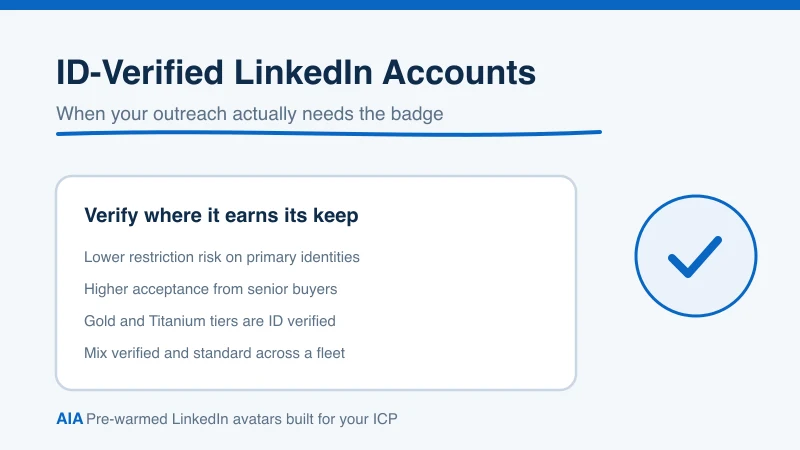
- Gold $147, ID verified
- Platinum $177
- Titanium $197, ID verified
Because Gold and Titanium are the ID-verified options, you can build a fleet where your primary identities and your senior-buyer plays run verified, while your high-volume prospecting seats run on standard tiers. You get the trust where it matters without paying for it where it does not. Volume discounts stack on top, at 10 percent off from 10 avatars, 20 percent from 50, and 30 percent from 100, so a mixed fleet at scale stays economical. The full breakdown is on the AIA pricing page.
Two more things matter once you are running a fleet. First, every avatar is pre-warmed and seeded toward your ICP before you ever send from it, so a verified account is not just verified but ready. Second, AIA backs every profile with a 48-hour replacement SLA, so if a restriction does happen, your program does not stall while you rebuild an identity by hand.
The Short Version
ID verification is not a gimmick and it is not a must-have on every account. It is a lever. It lowers restriction risk and lifts reply rates on the profiles that carry your most important, most trust-sensitive outreach, and it is wasted spend when applied blindly to every seat in a high-volume fleet. The right move is to verify deliberately: harden your primary and senior-buyer identities, run standard accounts for volume, and let the mix follow the value of the conversations each account is having.
If you are building or scaling an outreach fleet and want to think through which seats should be verified and which should not, you can review the tier options at getaia.io or see how to start with AIA. When you are ready, place your order and we will get your first avatars provisioned.
If you want to talk through what setup makes sense for your team, reach out on WhatsApp at wa.me/37256084933.